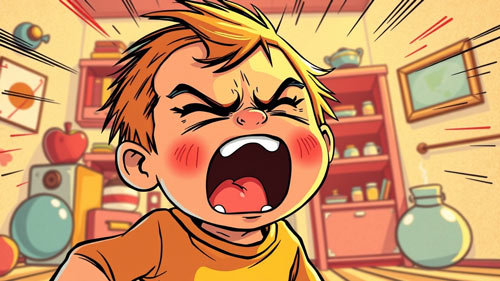
My Mother often tells me "a perfect child is a boring child" and I kind of get where she's coming from when she says this. I think it stems back from the days when children were meant to be seen but not heard. I thinks she's saying that a child who has no child behavior problems, does everything without needing to be asked, always keeps their emotions in check, and needs little or no parental guidance, could easily become a part of the background.
But the truth is, in many ways it's heartening to see the spirit in our children, their fire, their ability to reason and question, and yes, even their occasional outburst. All this can be considered "normal" or perhaps more accurately "usual" child behavior. It's how our children learn to be assertive, to understand boundaries and consequences (and responsibility), to learn what child behavior is both acceptable and unacceptable, and to develop their sense of independence as they grow older.
The expectations regarding child behavior have changed dramatically over the last 50 years or so, to the point where having a child who blindly follows every command, speaks only when spoken to, and who displays little or no emotion, would be as alarming as the child who refuses all commands, has constant outbursts, shows no respect for others, and who ignores basic social etiquette. When talking about child behavior I guess what most parents want is a child who isn't "perfect" (in the way of being emotionally stunted), who requires and responds to our guidance, has a voice and is connected to those around them, and a child who shows compassion and respect to others.
Child behavior is complex. In fact child behavior experts devote years of study and research into this field, and still there are varying professional opinions and practices. To make it simple for us parents is to remember that we know our kids better than anyone. We need to have faith in our parenting, but equally, we need to recognize when the behavior of our children needs guiding, and also when we should seek out professional help.
Child behavior encompasses the various ways in which children express themselves and interact with their environment, often presenting challenges for parents and caregivers. Navigating these behaviors can be complicated by conflicting advice from family, educators, and experts on effective discipline strategies. A strong, trusting relationship between parent and child is crucial, as it allows for the use of love and compassion in addressing behavioral issues. Rather than resorting to immediate but ineffective responses like spanking or yelling, constructive behavior modification techniques are encouraged to foster positive development and understanding in children.
Child behavior problems can be many and varied, but by being confident in our parenting, open, receptive and consistent, and by recognizing when help is needed, most child behavior problems can be dealt with effectively.